
Editorial and clinician review pending. This content is for general information and is not personal medical advice.

If you are considering XERF in Seoul, the useful first step is a skin assessment that connects your concern, health information, travel schedule, and the exact proposed device plan. It is not enough to recognize a treatment name online. XERF is described by its manufacturer as a non-invasive, dual-frequency monopolar radiofrequency (RF) platform, but that description does not confirm the tip, settings, local intended purpose, or suitability for an individual visitor. Those are the questions a consultation should answer.
At Daybeau Clinic Myeongdong Signature, a discussion can begin with the part of your face or skin quality that concerns you and what you hope to understand. It should end with clarity about whether XERF is worth considering, what remains uncertain, and what follow-up would be realistic if you are in Korea for a limited time. It should not begin with a promise of a particular change, a fixed duration, or “zero downtime.”
Key Takeaways
- XERF is a dual-frequency monopolar RF platform described as using 6.78 MHz and 2 MHz; the exact tip, protocol, and locally applicable purpose still need confirmation for your plan.
- The currently available human XERF study is small, retrospective, single-center, and uncontrolled. It can inform questions, but it cannot predict an individual outcome or duration.
- A good consultation identifies the proposed treatment area, reviews relevant history and prior procedures, and explains risks, alternatives, aftercare, and travel implications before you decide.
- International visitors should build in time to understand the plan and know who to contact if they have questions after leaving Seoul.
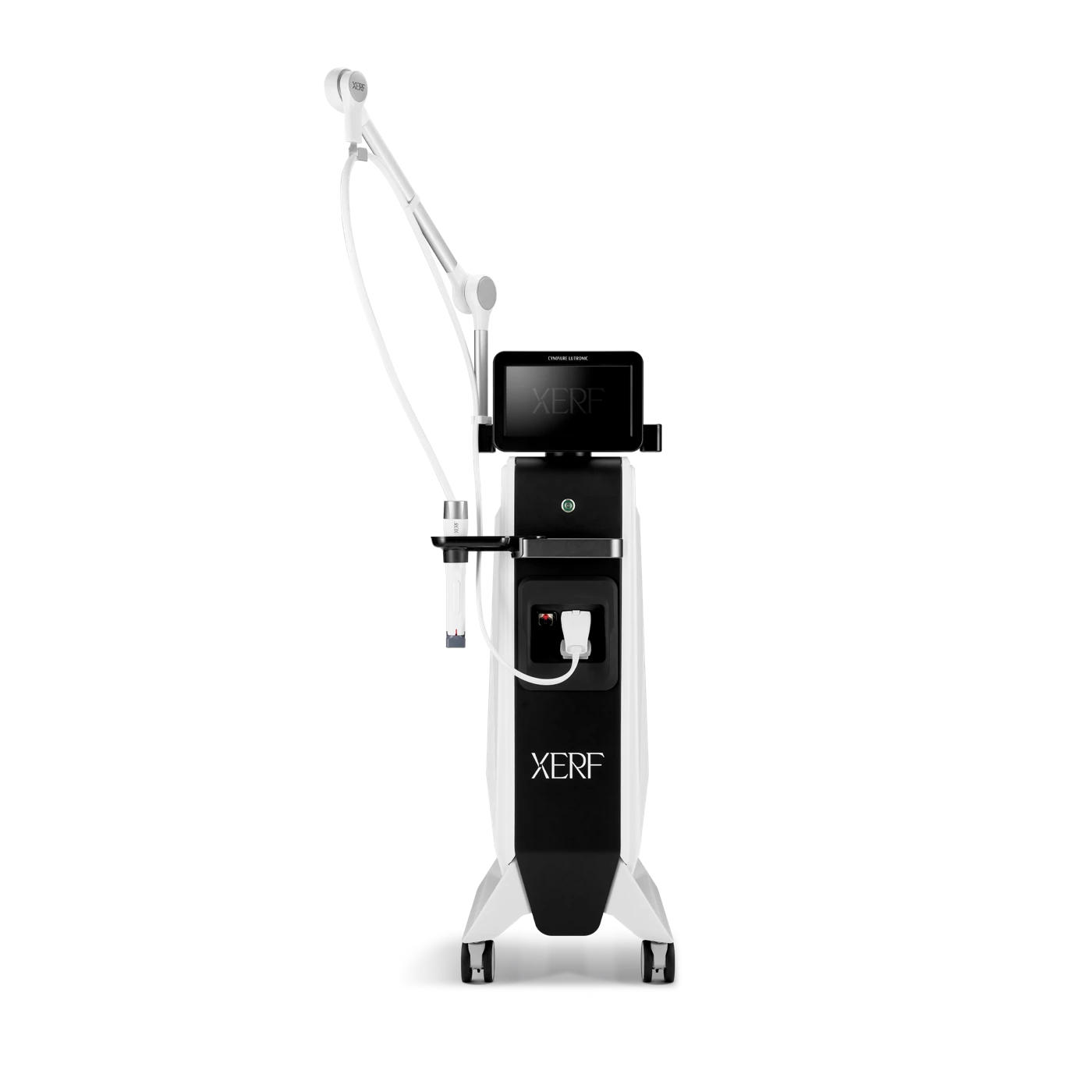
Product images supplied by the clinic. They identify device models and do not show treatment results.
What XERF means—and what the name does not tell you
XERF is an energy-based platform, not a diagnosis or a universal solution for skin concerns. The manufacturer describes XERF as a multifrequency monopolar RF system that combines 6.78 MHz and 2 MHz. Its page also describes cooling and adjustable depth and intensity features. Those are platform descriptions; they are not proof that a particular setting, tip, or treatment goal is right for every person (Cynosure Lutronic, XERF).
A device name also cannot settle the regulatory or practical details that matter in Seoul. The same manufacturer page says it is intended for U.S. distribution and states a U.S. device purpose related to dermatologic and general surgical procedures. It should therefore not be used to infer the locally authorized purpose in Korea, the equipment configuration at a particular clinic, or the precise plan that may be discussed with you. Ask the clinic to identify the exact platform and tip, the purpose proposed for your area of concern, and the information that supports that use in your circumstances.
This distinction is especially important when online content uses broad words such as “lifting,” “tightening,” or “collagen.” They can describe goals or mechanism discussions, but they do not forecast how a given person will look, feel, or respond. Skin laxity, texture, fine lines, facial volume, fat distribution, and structural changes can overlap visually while calling for different conversations. A facial assessment is the time to distinguish the concern rather than forcing it into the treatment name.
What the XERF evidence can—and cannot—answer
The available evidence should help you ask sharper questions, not replace individualized assessment. A 2025 human study of a dual-frequency non-invasive monopolar RF system reported on 20 volunteer participants at one institution. Each received one treatment, and the final assessment was at 12 weeks. The investigators used standardized photographs, evaluator review, participant satisfaction measures, and pain scores; they also recorded unexpected adverse events (Hwang, 2025).
That design has meaningful limits. The authors describe it as retrospective, single-institution, and without a control arm, and they note possible selection bias. The report can provide early, device-specific context, but it cannot establish that the same protocol will suit another person, predict the degree of change for a traveler, or prove how long any change will last. Its study population, tip, settings, treatment area, and follow-up may not match the plan discussed at a clinic in Seoul.
There is also a 2025 porcine-model paper on XERF that compared a 6.78 MHz setting with a combined 6.78 MHz plus 2 MHz setting. The study used three female pigs and examined tissue findings up to one month. It is useful for discussing preclinical mechanism and surface-temperature monitoring, but it is not human clinical-outcome evidence and cannot establish a patient result, duration, or safety profile in people (Hong et al., 2025).
The practical conclusion is simple: do not turn a study result or a manufacturer statement into a personal forecast. Ask which evidence is relevant to the exact purpose and protocol proposed for you, how closely it resembles your treatment area, and what the evidence does not answer. That conversation is more valuable than trying to derive a guaranteed result from before-and-after content, a device label, or a single research paper.
What a skin assessment should cover before any decision
A consultation should start with your own concern in plain language. You might be focused on lower-face laxity, fine lines, texture, or a change you notice in photographs. A clinician can then assess whether the concern is primarily one that an energy-based discussion may address or whether another approach, no procedure, or more information makes sense. General online content cannot make that distinction for you.
Bring a concise, accurate record of relevant health information and prior aesthetic procedures. In particular, share prior energy-based treatment, injectable treatment, surgery, implants, current skin irritation or sensitivity, and any factors the clinic asks about. The goal is not to self-screen; it is to give the clinician enough context to decide whether a plan should be considered, deferred, changed, or not recommended.
Use the appointment to get specific answers. Helpful questions include:
- What exact XERF platform, tip, and treatment area are being considered?
- What is the proposed purpose for my concern, and what local indication or clinical basis applies to that plan?
- Which settings, cooling approach, and comfort plan are expected to be relevant, and why?
- What benefits are realistic to discuss, what cannot be predicted, and what alternatives are reasonable?
- What reactions, aftercare steps, and follow-up arrangements should I plan for if I am leaving Korea soon?
The clinic’s XERF treatment consultation page is a useful starting point for these questions. It emphasizes that available tips, the local indicated purpose, individual suitability, energy planning, cooling, and aftercare need confirmation. A treatment page is not a substitute for that confirmation.
Comparing XERF with other energy-based conversations
The right comparison is based on technology, treatment purpose, evidence, and personal suitability—not on which name appears most often in social media. For example, the clinic describes Thermage as a monopolar RF conversation and Ultherapy as a microfocused ultrasound-with-visualization conversation. These are distinct technologies. Their installed generation or configuration, proposed area, evidence, precautions, comfort planning, and aftercare should each be verified independently.
That is why “Which treatment is best?” has no reliable universal answer. An RF platform may be part of an appropriate discussion for one concern, while another technology, a different treatment category, or no procedure may be more appropriate for someone else. The assessment should examine what is actually being proposed and why, rather than treating different energy-based services as interchangeable.
For a related discussion of questions to ask around another RF platform, see the Thermage consultation guide in Myeongdong. If you are comparing non-RF energy approaches, the Ultherapy consultation guide explains why installed platform details and personal assessment also matter there.
Risks, limitations, and aftercare questions
Non-invasive does not mean risk-free or identical for every person. In the 20-participant human study, the authors reported mild-to-moderate treatment pain and no unexpected adverse events during the study period. Their safety review specifically tracked issues such as prolonged redness, post-inflammatory hyperpigmentation, and texture changes. That is reassuring context within the study, but it is not a complete risk profile and should not be interpreted as a guarantee for a different person, setting, or protocol (Hwang, 2025).
The clinic’s general XERF information lists temporary sensitivity or redness as topics to discuss and notes that energy settings require individual planning. During your consultation, ask what reactions the clinician expects for the proposed area, what would be unusual, and how you should contact the clinic if you have concerns. The small clinical study and the preclinical model do not establish that every person will have the same comfort level, visible reaction, recovery timing, or response.
Before leaving, make sure you understand the aftercare instructions that apply to your actual plan and have a direct contact route for questions. Prolonged or increasing redness, unexpected pigment change, or a texture change are examples of concerns the human study monitored; they are sensible reasons to contact the treating clinic for guidance. If you feel a symptom is urgent, seek timely local medical care. This article cannot assess symptoms or replace clinician advice.
It is also reasonable to ask whether another treatment, a longer observation period, or no procedure is preferable. An informed choice includes the option not to proceed. Do not commit to treatment because of a short travel window, a promotion, or an assumption that a device label guarantees a particular result.
Planning a Seoul visit around a consultation
For overseas visitors, practical planning is part of safety and decision-making. Daybeau Clinic Myeongdong Signature is listed near Euljiro 1-ga Station, Exit 6, in central Seoul. A convenient location can simplify a consultation visit, but it does not remove the need to consider time for assessment, consent, possible aftercare, and communication after departure.
Share your arrival and departure dates when you make a request. Ask whether you are seeking a consultation only or whether treatment could be discussed during the same visit, and do not treat a request as a confirmed appointment. If follow-up would matter to the proposed plan, ask how it can be arranged before you leave Korea. Avoid assuming a fixed recovery timetable or scheduling decisions around a promised absence of visible reactions.
You may also want to decide in advance what information you need in a language you understand: the device name, purpose, alternatives, risks, aftercare, and contact process. The clinic’s international-patient information and the Seoul skin clinic travel-planning guide can help you prepare those practical questions before a visit.
A useful outcome from an XERF consultation
The best result from a first consultation may be clarity, even if you do not decide on treatment that day. You should leave knowing what concern was assessed, what technology is actually being considered, what it is intended to address, which limitations remain, and how your travel plans affect the decision. That is a sounder basis for consent than a treatment-name search alone.
If you would like to discuss XERF or another energy-based option in the context of your visit to Seoul, you can Request a consultation. This is an editorial draft for general education, not personal medical advice, diagnosis, or a promise of results. Editorial and clinician review are pending.
Sources
- Cynosure Lutronic: XERF
Manufacturer description of XERF as a multifrequency monopolar RF system combining 6.78 MHz and 2 MHz, platform cooling and settings descriptions, and the page’s U.S.-distribution and intended-use statement.
- Evaluation of the clinical safety and efficacy of a noninvasive dual-frequency monopolar radiofrequency treatment for facial laxity and fine wrinkles
Study design, 20-participant retrospective single-center human evidence, 12-week follow-up, safety monitoring, mild-to-moderate pain, no unexpected adverse events, and the study authors’ stated limitations.
- Safety and efficacy of a novel non-invasive monopolar radiofrequency device for skin tightening in a porcine model in Republic of Korea: pre-clinical study
Preclinical XERF dual-frequency porcine-model design, tissue and surface-temperature observations, and the limits of using animal findings as human clinical-outcome evidence.
Frequently asked questions
What is XERF?
XERF is described by its manufacturer as a non-invasive multifrequency monopolar radiofrequency platform that combines 6.78 MHz and 2 MHz. The exact tip, protocol, intended purpose, and suitability for an individual should be confirmed during a consultation.
Can a XERF consultation predict my result or how long it will last?
No. Available research can help frame a discussion, but it cannot predict an individual result or duration. Your treatment area, skin characteristics, proposed protocol, health history, and follow-up all matter.
What should I ask about the XERF device before deciding?
Ask for the exact platform and tip, the treatment area and purpose proposed for you, the applicable local indication, the evidence and limitations, expected reactions, alternatives, aftercare, and how to contact the clinic with questions.
How should I plan XERF around travel to Seoul?
Share your arrival and departure dates before arranging a visit. Confirm whether you are requesting a consultation only or discussing treatment, what follow-up may be needed, and how you would obtain support after leaving Korea. Do not assume a fixed recovery period or a guaranteed absence of visible reactions.