
Editorial and clinician review pending. This content is for general information and is not personal medical advice.

Editorial status: Medical review pending. This draft is general education for people considering a consultation and is not personal medical advice.
Ultherapy in Myeongdong is best approached as a consultation about whether a specific ultrasound-based plan fits your concern, health information, and Seoul itinerary—not as a treatment to book simply because the name is familiar. Daybeau Clinic Myeongdong Signature does not publicly confirm the exact installed Ultherapy generation or configuration. The first conversation should identify the device and proposed use before you decide whether to proceed.
For a visitor, the question is also whether comfort, aftercare, and access to follow-up fit a short trip. This guide explains what to verify, what the evidence can reasonably tell you, and how to prepare for a consultation in central Seoul.
Key Takeaways
- Ultherapy is associated with microfocused ultrasound with visualization (MFU-V), but a treatment name does not confirm the exact model or plan available at a clinic.
- Suitability requires an individual assessment; published evidence can inform the conversation but cannot predict a personal result.
- Pain or discomfort, redness, swelling, and temporary nerve-related effects are among the issues to discuss before treatment.
- International visitors should plan around treatment timing, aftercare, and how they would obtain advice after leaving Seoul.
What Ultherapy is—and what needs confirmation in Myeongdong
Ultherapy is commonly associated with microfocused ultrasound with visualization, or MFU-V. In U.S. FDA clearance material for the Ulthera System, focused ultrasound is used to make temporary changes in the skin’s appearance. With the DeepSEE transducer, the system can visualize tissue layers to help confirm skin contact and appropriate treatment depth, including avoiding bone (FDA 510(k) K243035).
This is background, not a promise about a Korean appointment. The FDA document concerns a U.S. device and U.S. indications; it does not establish the Korean indication, exact hardware, available transducers, or an individual recommendation at Daybeau Clinic. The clinic’s verified information likewise does not confirm whether the original platform or Ultherapy PRIME is installed. Confirm those details directly before care is planned.
Why the exact platform and plan matter
“Ultherapy” is not enough information to compare consultations. Ask the clinic to identify the control unit or generation, the proposed treatment area and transducer, and why it is being considered. Do not assume a particular visualization feature or protocol from the treatment name alone.
The manufacturer’s patient information describes U.S. FDA-cleared uses for brow lifting; lax tissue under the chin and on the neck; and lines and wrinkles of the décolleté, with later U.S. clearance material also addressing certain body areas (Ultherapy PRIME FAQs). These are device- and country-specific statements. They do not determine your suitability in Seoul.
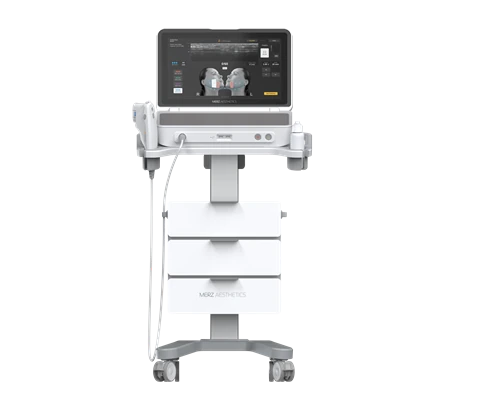
Product images supplied by the clinic. They identify device models and do not show treatment results.
For the clinic’s consultation framing, see the Ultherapy treatment consultation page. It is a prompt for questions, not confirmation of a device model or plan.
Who may be suited to an Ultherapy discussion?
Suitability cannot be self-diagnosed from an online checklist. It begins with the change you want to discuss, the location and degree of laxity, and whether a nonsurgical energy-based approach matches your expectations. A clinician also needs relevant health information and a record of prior procedures before deciding what is appropriate.
A 2023 systematic review of microfocused ultrasound for facial skin tightening found varied device settings, energies, and protocols across its included studies, all of which enrolled female patients. The authors concluded that MFU could tighten mildly to moderately lax facial skin, while noting unavailable longer-term follow-up data and a need for stronger objective outcomes and male-patient research (Contini et al., 2023). These findings can guide questions about a goal, but they cannot tell a specific person what change to expect.
Start with the concern, not a device label
Describe your area of concern and what would count as a meaningful, realistic improvement. Mention previous energy-based treatments, surgery, threads, injectable treatments, implants, or other relevant history. These details can affect whether an ultrasound-based plan is considered.
It is also useful to say what you do not want. Someone seeking a substantial structural change may need a broader alternatives discussion rather than a one-device answer. The manufacturer describes Ultherapy PRIME as not replacing a surgical facelift (Ultherapy PRIME FAQs). That does not make surgery appropriate for any individual; it simply prevents a nonsurgical consultation from being framed as a substitute for every lifting goal.
What the evidence can—and cannot—answer
The evidence supports a measured conversation, not a universal forecast. The systematic review identified improvement in the studies it evaluated, but results used different protocols and outcome measures, and long-term data were limited. It is more accurate to ask how the proposed plan relates to your concern than to use a study result as a promised degree or duration of change (Contini et al., 2023).
The FDA clearance document is also narrow. It describes intended U.S. uses and imaging for the Ulthera System; it does not validate every schedule, clinical claim, or international use of the name (FDA 510(k) K243035). A consultation should separate evidence for the device and treatment area under discussion from broad claims about “lifting.”
Ask these practical evidence questions:
- What exact device and transducer would be considered for my treatment area?
- What is the intended purpose of this plan, and what evidence is relevant to that purpose?
- What limits of the evidence matter most for my goals and timetable?
These questions are more useful than asking for a guaranteed result.
What to cover at an Ultherapy consultation
A good consultation gives you enough detail to decide without assuming you must decide that day. Share your priorities, time in Korea, and whether you will be available locally after the visit. Ask for plain-language answers about the proposed technology and care plan.
Confirm the technology before discussing outcomes
Ask the clinic to confirm the installed platform or generation, planned treatment area, and whether visualization is part of the approach. If a device name, handpiece, or transducer is mentioned, ask what it is intended to do. The FDA’s U.S. clearance describes imaging for coupling and depth confirmation; it should not be reinterpreted as an outcome guarantee (FDA 510(k) K243035).
Ask whether there are reasonable alternatives for your goals. A Thermage consultation is a different radiofrequency-based conversation, while thread lifting involves a procedure with its own recovery considerations and risks. Neither link is a recommendation or a comparison of expected results; it is a route to discuss why one approach, or no treatment, may fit better.
Discuss comfort, aftercare, and decision timing
The manufacturer notes that people can feel heat or tingling during ultrasound delivery and that comfort levels vary (Ultherapy PRIME FAQs). Ask what the clinic expects you to feel, what comfort options it may discuss, and when you should speak up during the appointment.
Ask about anticipated short-term responses, instructions after the visit, and the process for questions once you leave. A consultation request is neither a confirmed appointment nor a commitment to treatment. If you need more time to consider the proposed plan, ask how that affects scheduling rather than forcing a decision into a travel day.
Risks, limitations, and when to seek advice
Ultherapy should not be described as having “zero downtime” or as risk-free. The manufacturer’s U.S. patient information says that the most common side effects reported in clinical trials were redness, swelling, pain, and transient nerve effects. It directs patients to speak with their practitioner about additional safety information and possible side effects (Ultherapy PRIME FAQs). The 2023 systematic review also described treatment as moderately painful and reported transient redness with or without swelling; other adverse effects were uncommon in its included studies (Contini et al., 2023).
Those findings do not define what will happen to you. Protocols, follow-up, treatment areas, and individual factors differ. “Rare” in reviewed studies is not a personal safety guarantee. Ask the clinician to explain risks relevant to your proposed area and plan, plus aftercare and follow-up access for a visitor.
Before leaving the clinic, know whom to contact if you have symptoms or concerns that are more intense, persistent, or unexpected than the care instructions describe. If timely advice is not available through the treating clinic, seek local medical assessment.
Planning around a Seoul trip
A Myeongdong location can make a visit easier to reach, but it does not remove the need for time and contingency planning. Daybeau Clinic Myeongdong Signature lists its location near Euljiro 1-ga Station, Exit 6, at B1, 84 Namdaemun-ro, Jung-gu, Seoul. Allow time for a conversation rather than packing a first consultation between airport transfers, tours, or a departure flight.
Before submitting a request, have your intended dates, preferred contact method, and a simple summary of your goals ready. The booking form asks for travel and preferred consultation dates, states that a request is not an appointment confirmation, and asks visitors not to include medical records, sensitive health details, or photos. Those details can be discussed through the appropriate consultation process instead.
Consider whether you can stay reachable after the visit, who can help with communication if needed, and what flexibility you have if the clinician advises against treatment that day. For visitor information, see International Patients. For broader trip logistics, the related article slug seoul-skin-clinic-travel-planning is paired with this draft for site integration.
A considered next step
If you are weighing Ultherapy in Myeongdong, prioritize clarity over speed. Confirm the actual device and local purpose, explain your goals and prior treatment history, ask about risks and alternatives, and make sure the plan fits your ability to obtain advice after the visit. Public evidence can help you ask better questions; it cannot replace an individual clinical assessment.
When you are ready to begin that conversation, Request a consultation.
Sources
- FDA 510(k) K243035: Ulthera System
U.S. device description, indications for use, and the imaging function; it is not used to infer Korean availability or individual suitability.
- A Systematic Review of the Efficacy of Microfocused Ultrasound for Facial Skin Tightening
Evidence scope, study-population limitations, protocol variation, adverse-effect discussion, and limits of longer-term follow-up.
- Ultherapy PRIME FAQs
Manufacturer patient information on U.S. cleared uses, variable comfort, common reported side effects, and the statement that treatment is not a replacement for a surgical facelift.
Frequently asked questions
Does “Ultherapy” confirm that Ultherapy PRIME is available at the clinic?
No. Daybeau Clinic’s verified public information does not confirm whether the original platform or Ultherapy PRIME is installed. Ask the clinic to identify the exact platform, available transducer, and proposed use. A brand name alone does not define a configuration or protocol.
Can I plan an Ultherapy consultation during a short Seoul visit?
You can request a consultation while visiting Seoul, but a short stay should not turn it into a rushed treatment decision. Share arrival and departure dates, ask about aftercare and contact options, and leave time to consider the recommendation. A request is not an appointment confirmation or a guarantee that treatment will be advised.
Is U.S. FDA clearance the same as approval or suitability in Korea?
No. The FDA document describes U.S. clearance and intended use for the Ulthera System; it does not confirm Korean authorization, the exact device at a Seoul clinic, or individual suitability. These points need local clarification during consultation ([FDA 510(k) K243035](https://www.accessdata.fda.gov/cdrh_docs/pdf24/K243035.pdf)).
What should I ask if I am deciding between Ultherapy and another lifting option?
Ask which technology or procedure is being discussed, why it is being considered for your concern, what evidence relates to that plan, and what risks, limits, aftercare, and follow-up needs apply. You can also ask whether [Thermage](/en/treatments/thermage/) or [thread lifting](/en/treatments/thread-lifting/) is relevant. No option should be assumed appropriate without an individual assessment.