
Editorial and clinician review pending. This content is for general information and is not personal medical advice.

If you are considering Thermage in Myeongdong while visiting Seoul, the useful starting point is not a fixed number of shots, a named tip, or a promised result. It is an individual conversation about what concerns you, the exact device and treatment tip proposed, your relevant health history, and whether the plan fits your time in Korea. Thermage is associated with non-invasive monopolar radiofrequency (RF), but the treatment name alone does not confirm the installed generation, available tip, local authorized purpose, or suitability for one person.
At Daybeau Clinic Myeongdong Signature, a Thermage consultation should help you decide whether the proposed approach is understandable and appropriate for you—not turn a general treatment name into a guarantee. This editorial draft is for general information, and clinician review is pending. It is not personal medical advice or a substitute for a consultation.
Key Takeaways
- Thermage is associated with monopolar RF; confirm the precise device generation and tip rather than assuming Thermage FLX is available.
- A useful plan begins with your goal, treatment area, health information, prior procedures, and travel schedule.
- Published evidence supports discussing RF as a non-invasive option, but it does not predict one person’s result, comfort, recovery needs, or duration.
- The manufacturer lists possible reactions including redness, swelling, bruising, blistering or burns, pigment change, altered sensation, and other effects; individual risks need review before treatment.
What “Thermage” tells you—and what it does not
Thermage is a brand name associated with monopolar radiofrequency treatment. In the U.S. FDA record for the Thermage FLX System, the system delivers RF energy through a disposable tip while conductively cooling the epidermis; the system also monitors skin contact during treatment (FDA 510(k) K170758). That explains the broad technology category. It does not establish what equipment, tip, treatment area, settings, or indication is proposed for a particular visitor in Seoul.
That distinction matters because a device family can have different generations and tips, and each treatment area needs its own planning. Solta Medical’s U.S. professional information describes a Thermage CPT/FLX system and several tips, including total, eye, and body options; this is manufacturer information for the U.S. market, not confirmation of any device or tip at a specific clinic in Korea (Thermage professional information). A clinic should identify the actual device and proposed tip directly during consultation.
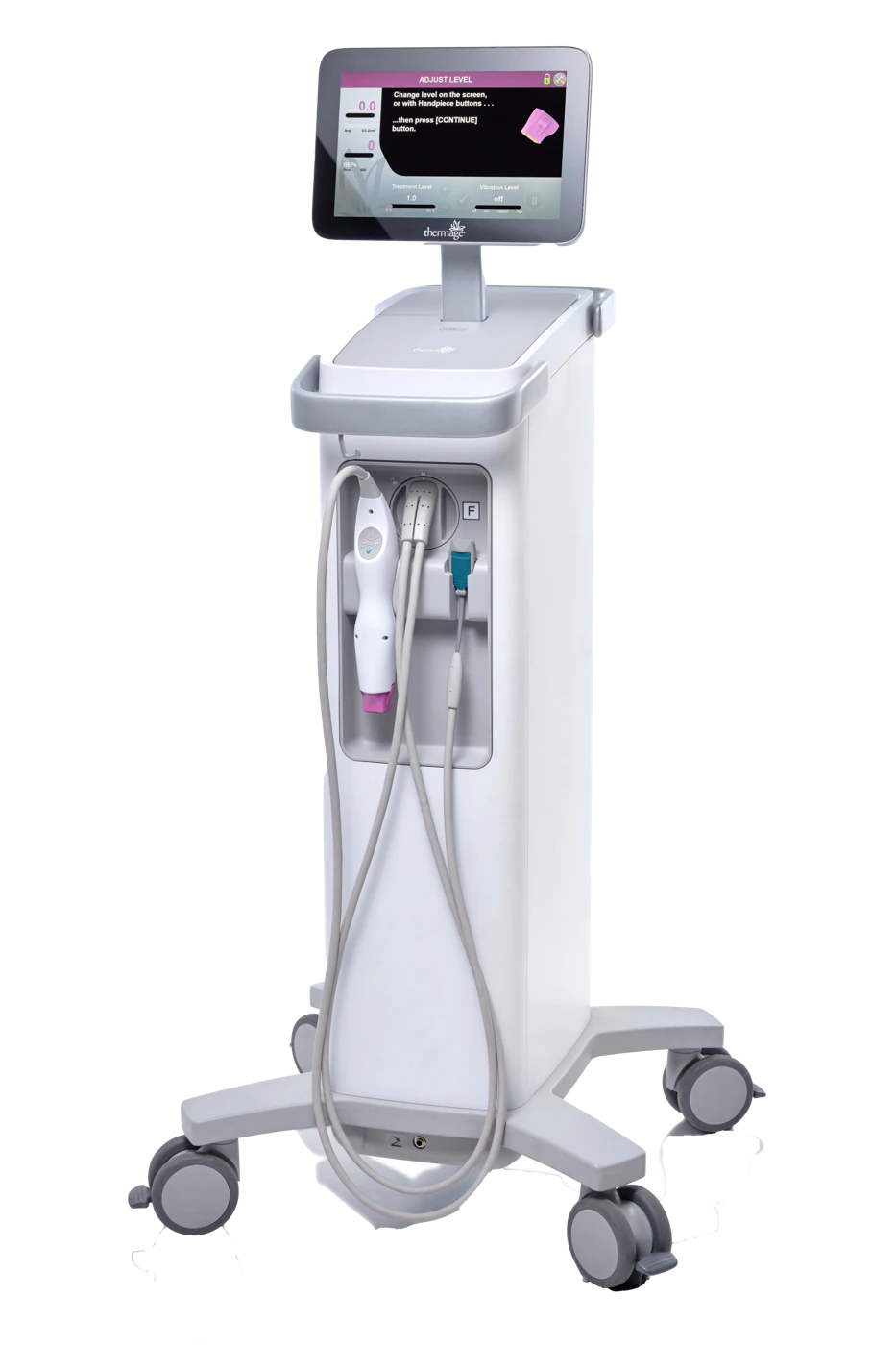
Product images supplied by the clinic. They identify device models and do not show treatment results.
The same caution applies to words such as “lifting,” “tightening,” or “contouring.” These words are often used broadly in aesthetic conversations. They are not a diagnosis, a device specification, or a reliable forecast of what an individual will see. A careful consultation separates the concern you want to discuss from the technology and plan that may—or may not—be appropriate.
Why individual RF treatment planning comes first
The first decision is the clinical question, not the brand. Some visitors want to discuss lines around the eyes, others notice changes in facial definition, and others are looking for a non-surgical option before deciding whether to consider a procedure. Bring that concern into the conversation in plain language. It is more useful than arriving with a preselected protocol or an expectation copied from someone else’s images.
Start with your priorities and treatment area
A consultation can clarify which area you want assessed, what change you are hoping to discuss, and what trade-offs matter to you. For example, the eyes, face, jawline, and body are not interchangeable treatment areas. The U.S. Thermage FLX labeling lists non-invasive treatment of periorbital wrinkles and rhytids, including upper and lower eyelids, and wrinkles and rhytids more generally; it also lists a temporary improvement indication for the appearance of cellulite when RF and vibration are used together (FDA 510(k) K170758). Those U.S. indications should not be treated as a statement about Korean authorization or about an individual plan.
Ask the clinician to connect the proposed area, the tip, the method, and the purpose in one clear explanation. If the discussion concerns the eye area, it is reasonable to ask about the safety steps planned for that area. Solta’s professional safety information says that treatment of the eyelids or within the orbital rim requires plastic eye shields and contains specific warnings about vibration in that context (Thermage professional information). The point is not to self-direct treatment; it is to understand why a specific plan has its own precautions.
Confirm the exact device, tip, and local context
Do not infer that “Thermage” means a particular generation. Daybeau’s verified clinic information specifically states that the FLX generation and available tips need confirmation at the clinic. Before making a decision, ask what model is proposed, which tip would be used, what area it is intended to address, and why that combination is being considered for you.
It is also worth asking whether the proposed use is consistent with local requirements and product information. An FDA clearance record is useful evidence about a U.S. device record, but it is not a Korean regulatory decision, a verification of the clinic’s installed model, or a promise of availability. The treatment name alone cannot supply those missing facts. A clear answer from the clinic is more meaningful than a marketing label.
Share health and treatment history openly
Relevant health history can change the conversation. The manufacturer lists implantable pacemakers, automatic implantable cardioverter/defibrillators, and other implantable electrical devices as contraindications for the Thermage CPT/FLX system because RF fields or current may adversely affect them (Thermage professional information). This is a reason to disclose those devices before a plan is made, not a reason to rely on an online checklist for personal clearance.
Prior injectable treatments, implants, procedures, allergies, active skin concerns, and medicines are also useful to discuss. Solta says it has not studied Thermage over skin fillers and lists several populations or conditions in its precautions; the clinician needs to determine whether any of that is relevant to your situation. Have your information available in a format that you can explain accurately, especially if you are travelling from another country.
What the evidence can reasonably support
The evidence supports a measured conversation about monopolar RF, not a standardized outcome. The FDA’s Thermage FLX record describes delivery of RF energy with conductive epidermal cooling and skin-contact monitoring (FDA 510(k) K170758). That technical description helps explain why treatment planning includes the area, tip, contact, cooling, and protocol. It does not tell a visitor how much change they will see, how comfortable treatment will feel, or how long a change may last.
A peer-reviewed article in the Journal of the American Academy of Dermatology evaluated a nonablative monopolar RF device in six people who had six treatment sessions over three months. The authors used photographs, biopsies, and blinded photo scoring in their study design (El-Domyati et al., 2011). This small, multi-session study adds biological and clinical context for the category, but it cannot predict the outcome of a single Thermage consultation, a different device, a different protocol, or one person’s response.
For a visitor, the practical implication is straightforward: ask what evidence is relevant to the exact device and proposed use, and ask what the limits of that evidence are. Be cautious when a discussion turns a device category, a historical study, or a brand image into a precise promise about lifting, collagen change, comfort, recovery, or duration. Individual response, treatment area, protocol, skin characteristics, and follow-up all matter.
Risks, limitations, and questions that should not be skipped
A non-invasive label does not mean risk-free. In the manufacturer’s U.S. safety information, reported adverse patient reactions include mild-to-moderate pain during treatment and, after treatment, edema, erythema or blanching, urticaria, bruising, blisters, burns, scabbing or scarring, surface irregularities, altered sensation, lumps or nodules, pigment change, and rare herpes simplex reactivation in certain areas (Thermage professional information). These are listed reactions, not a prediction that they will happen to you or a statement about their frequency.
Discuss what risks are relevant to your proposed area and health history, as well as how the clinic plans to explain aftercare. It is also reasonable to ask whom to contact if you have a concern after leaving the clinic. If you experience a possible reaction that concerns you—such as blistering, a burn-like change, unusual sensation, or a concerning eye symptom after treatment near the eye area—seek prompt assessment from an appropriate clinician rather than trying to manage it alone while travelling.
The limits are as important as the risks. General online information cannot confirm a clinic’s model, availability, local authorization, recommended setting, candidacy, or expected result. It also cannot settle whether another treatment, a procedure, or no treatment is the better choice for your priorities. Do not accept “no downtime,” a fixed duration, or guaranteed results as substitutes for a personalized discussion. Those claims are not appropriate assurances for an individual plan.
For eye-area discussions, the distinction between an approved treatment plan and casual terminology is especially important. The manufacturer’s published safety information is specific about eye shields and warnings for treatment around the eyes (Thermage professional information). Ask the treating clinician to explain the proposed area and precautions in a way you understand before you choose to proceed.
Planning a Thermage consultation around a Seoul visit
International visitors should plan the conversation as carefully as the treatment. Daybeau Clinic Myeongdong Signature is near Euljiro 1-ga Station, Exit 6, which may make a consultation straightforward to fit into a central Seoul itinerary. Convenience should not create pressure to decide quickly. A consultation request is not a confirmed medical appointment, and the clinic should confirm availability and next steps directly.
When you contact the clinic, share your arrival date, the date you hope to visit, and whether you have flexibility if a consultation suggests that more time, a different option, or no treatment is appropriate. Leave room in your schedule to hear the discussion, ask questions, and follow any personalized guidance. Avoid building an itinerary around an assumed same-day treatment or a particular recovery pattern.
Bring a concise record of prior aesthetic procedures and products if you have them, along with relevant medical information and a current medication list. If you have information in another language, a dated photo or translated summary can make the consultation clearer. Ask how you would obtain support if you had a concern after leaving Seoul, and consider whether your travel plans allow for the follow-up that a clinician may recommend.
The clinic’s international patient information is a useful place to review the visit-request process. It does not replace a clinician’s assessment, but it can help you prepare practical questions before you travel.
Comparing Thermage with other treatment conversations
Comparisons should start with technology and purpose, not a claim that one option is universally better. Ultherapy is associated with microfocused ultrasound with visualization, rather than monopolar RF. That difference means the device, treatment plan, comfort conversation, evidence, and precautions should be discussed on their own terms. The exact installed Ultherapy generation also needs confirmation at consultation.
XERF is another energy-based treatment conversation, described in the clinic’s verified information as a monopolar RF platform combining two frequencies. That does not make it interchangeable with Thermage, and it does not establish that it is suitable for you. Ask what technology is being proposed, what it is intended to address, what evidence supports that use, and what limitations apply.
A clinician may also discuss other approaches or advise against a particular energy-based treatment. Your alternatives can include a different modality, a procedure, a skin-care approach, postponing a decision, or choosing not to treat. The safest comparison is the one that acknowledges uncertainty and does not combine treatments simply to fit a short visit to Seoul.
A consultation checklist for foreign patients
Bring questions that make the plan specific. Ask which device generation and tip are proposed; which treatment area and purpose are being discussed; what health information or previous treatments matter; what discomfort, visible changes, and aftercare may be relevant; and who will support you if you are travelling after your visit. Ask whether the proposed use and product details can be explained clearly before any decision.
You can also ask what alternatives are reasonable for your concern and why the clinician does or does not recommend the option under discussion. A good consultation leaves you with information you can consider. It should not require an immediate decision or rely on a promised result.
Next step: request an informed consultation
If individual RF treatment planning in central Seoul is what you want to discuss, begin with the facts that only a clinic consultation can confirm: your concerns, health and treatment history, the exact device and tip, and your travel timing. Daybeau Clinic Myeongdong Signature can discuss whether a Thermage conversation is appropriate for your visit.
Sources
Sources
- Thermage professional information: indications and important safety information
Manufacturer description of Thermage CPT/FLX indications, contraindications, precautions, eye-area warnings, and reported adverse patient reactions.
- U.S. FDA 510(k) K170758: Thermage FLX System
FDA-cleared U.S. Thermage FLX device description, indications for use, RF delivery, epidermal cooling, and skin-contact monitoring; not a Korean authorization or clinic-device verification.
- El-Domyati et al., Radiofrequency facial rejuvenation: Evidence-based effect
Peer-reviewed context for a small, multi-session study of nonablative monopolar radiofrequency and the limits of extrapolating category evidence to an individual plan.
Frequently asked questions
What should I confirm before considering Thermage in Myeongdong?
Ask the clinic to identify the exact device generation and tip, the proposed treatment area and purpose, relevant local considerations, anticipated aftercare, and why the plan is being discussed for you. The Thermage name alone does not confirm those details.
Is Thermage FLX available at Daybeau Clinic Myeongdong Signature?
The clinic’s verified information does not confirm an installed generation or available tips. Please ask the clinic directly during your consultation request rather than assuming that Thermage FLX or a particular tip is available.
Why should I disclose prior fillers, implants, and medical history?
Prior treatments, implanted devices, health conditions, and medicines can affect whether and how an energy-based treatment is considered. The manufacturer lists implantable electrical devices as contraindications for the Thermage CPT/FLX system and notes precautions that require individual clinical discussion.
How should I plan a Thermage consultation around travel in Korea?
Share your arrival and departure dates, allow time for a consultation and individualized aftercare discussion, and ask how to seek support if you have a concern after leaving Seoul. Do not assume a same-day treatment, a fixed recovery pattern, or a guaranteed outcome.