
Editorial and clinician review pending. This content is for general information and is not personal medical advice.

If you are considering a “Titanium treatment” in Korea, the most useful first step is not choosing a package or predicting an outcome. It is verifying the exact device, the purpose it is being proposed for, the local authorized use, and the protocol that would apply to you. In Korean aesthetic settings, “Titanium lifting” can be a marketing or protocol name. It does not, by itself, identify a manufacturer, a model, a handpiece, an authorized facial-lifting indication, or a level of supporting evidence.
That distinction matters for international visitors. A laser platform may have well-described evidence for one purpose, while a separate facial protocol may require a different evidence discussion. At Daybeau Clinic Myeongdong Signature, a Titanium conversation should begin with those details rather than with assumptions based on a treatment name. This editorial draft is for general education, is not personal medical advice, and remains pending medical review.
Key Takeaways
- “Titanium” is not a complete device identification or a confirmed facial-lifting indication.
- Alma’s Soprano Titanium is presented by its manufacturer as a 755/810/1064 nm diode hair-removal platform, not as proof that every use of the word Titanium is the same treatment.
- Hair-removal research on a triple-wavelength platform does not establish facial-lifting effectiveness.
- A separate diode-laser facial-laxity study used a different 810/940 nm device; it cannot be transferred automatically to Soprano Titanium or to a local protocol.
- Before travel, ask for the model, proposed purpose, local authorization, treatment plan, risks, aftercare, and an appropriate contact plan.
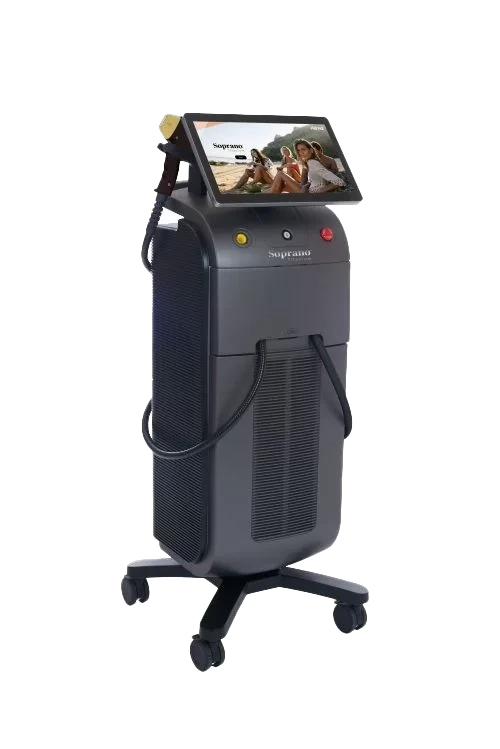
Product images supplied by the clinic. They identify device models and do not show treatment results.
Why the word “Titanium” needs verification
The direct answer is simple: a treatment label is not the same thing as a verified device-and-purpose record. Names may refer to a branded platform, a locally used protocol, a handpiece, or a marketing description. Those possibilities are materially different when a visitor is deciding whether to proceed.
The device evidence supplied for Daybeau identifies Alma Lasers’ Soprano Titanium as a diode laser platform associated with 755, 810, and 1064 nm wavelengths. Alma’s current product page categorizes the Special Edition of Soprano Titanium as hair removal and explains that its three wavelengths are emitted together to address anatomical structures within the hair follicle (Alma Lasers). That is a clear manufacturer description of a particular platform and purpose. It is not evidence that an identically named facial “lifting” protocol has the same intended use, parameters, or expected effects.
What Soprano Titanium evidence does—and does not—show
The manufacturer page is useful because it gives a concrete reference point: a product called Soprano Titanium is designed around hair removal, multi-wavelength diode delivery, and cooling. It also describes the three wavelengths as 755, 810, and 1064 nm. The page does not turn the word “Titanium” into a generic category of facial-lifting treatments, and it does not confirm which model, if any, is installed at an individual clinic.
The peer-reviewed study cited by the manufacturer is also purpose-specific. In a prospective, dual-center, single-arm study, 36 participants received four treatment sessions with a triple-wavelength diode module for hair removal in the underarm and bikini areas. The follow-up visit was three months after the final session. The authors reported a significant reduction in hair count and no serious adverse events in that study (Gold et al., Journal of Cosmetic Dermatology, 2023).
Those details are helpful, but their limits are just as important. The study evaluated hair reduction in defined body areas after a stated treatment schedule. It was not a facial-lifting trial. It did not test a Korean Titanium-lifting protocol, identify a universal facial setting, or establish that a visitor will have a particular response. A single-arm study also does not offer the same comparison as a randomized trial against another treatment or no treatment. Using the hair-removal evidence to promise facial tightening would be an unsupported leap.
Matching a wavelength is not enough
It can be tempting to assume that a familiar wavelength makes two devices or protocols equivalent. It does not. The full device, applicator, cooling method, energy delivery, treatment area, patient selection, session plan, and outcome measure affect what a study actually tells us.
For context, a 2015 study examined facial skin laxity using a MeDioStarNeXT diode laser with 810 and 940 nm wavelengths. Thirty participants had four sessions at three-week intervals. The authors reported improvements on several measures and described the treatment as safe and potentially effective, while about 10% of participants reported mild pain or minor adverse events (Voravutinon et al., Journal of Cosmetic Dermatology, 2015).
That study does not verify a Titanium facial plan. It involved another named device, a different wavelength combination, a small group of participants, and a particular four-session schedule. It may be relevant background when discussing diode-laser research, but it cannot substitute for evidence on the exact model and facial protocol being proposed in Seoul. The same caution applies if an online image, promotional phrase, or social-media post uses similar words without showing the device information.
The verification questions that matter before you decide
A useful consultation does not require you to arrive with technical expertise. It does require clear answers. Consider bringing the following questions in writing, especially if you are planning from overseas:
- What is the exact manufacturer and model? Ask to see the full device name rather than relying on “Titanium” alone. If the proposal refers to a handpiece or facial tip, ask for its exact name as well.
- What is the proposed purpose for my case? Ask whether the goal is hair reduction, a facial-skin concern, or something else. The desired outcome should be described in ordinary language, not only with a branded term.
- What is the local authorized purpose? A clinic should confirm how the proposed use is authorized locally and whether the intended use matches the device and plan. Do not infer this from an English-language product page, another country’s advertising, or a treatment name.
- What protocol is being considered? Ask about treatment area, number and timing of sessions, applicator, cooling, and any factors that could lead the clinician to modify or decline a plan. The answer should remain individualized; a generic setting or online protocol is not a personal recommendation.
- What evidence applies to this precise use? Ask whether the cited research is on the same device, same purpose, and comparable treatment area. It is reasonable to ask what the evidence does not answer, too.
- What are the alternatives? An informed discussion can include no procedure, skin-care approaches, or other energy-based options. Alternatives should be explained according to your concern, anatomy, previous procedures, preferences, and health information—not because a device name is popular.
These questions help convert a vague label into information you can evaluate. They also avoid a common mistake: treating a brand-like term as proof of suitability. No webpage can determine whether an energy-based treatment fits an individual person.
How to read claims without over-reading them
Next, separate technical plausibility from demonstrated clinical benefit. A device may deliver heat or particular wavelengths, but that alone does not establish a meaningful facial outcome for a particular person. A strong consultation should distinguish what the manufacturer says about its device, what peer-reviewed research studied, and what remains uncertain for the proposed plan.
Finally, be careful with the word “lifting.” It can mean different things in everyday marketing: a change in skin feel, an appearance-related goal, or a particular clinical endpoint. Ask the clinician to define what it means in your plan and how success would be assessed. Avoid making travel or scheduling decisions based on a promised degree of change or a promised duration. The studies above should not be read as guarantees of either.
Risks, limitations, and a response plan
The central limitation for “Titanium treatment Korea” searches is that the name alone does not identify the relevant risk profile. Laser suitability and potential reactions are protocol-specific and individual. The supplied clinic evidence therefore supports verifying the exact model, proposed purpose, protocol, skin history, and individual suitability before treatment rather than presenting a universal safety claim.
The two studies discussed here provide narrow safety information, not a universal assurance. The hair-removal study reported no serious adverse events among 36 participants under its protocol. The distinct facial-laxity study reported mild pain or minor adverse events in approximately 10% of 30 participants. Neither result can forecast an individual experience, and neither establishes safety for an unverified facial protocol.
Before consenting, ask what sensations or visible changes might be expected, what should prompt you to contact the treating clinic, who will respond outside normal hours if applicable, and where you should seek in-person assessment if you have already left Seoul. This is not about expecting a problem. It is about avoiding an avoidable gap in care when you are away from home. A clinician reviewing your history should determine which personal factors and prior treatments matter for a particular plan.
If the details remain unclear, delaying a decision is reasonable. A well-informed choice can include declining a procedure, choosing a differently supported option, or scheduling it when follow-up is easier. A request for clarity is not a commitment to treatment.
Travel considerations for Seoul visitors
International patients benefit from treating the consultation and the procedure decision as separate steps. Build time to ask questions, read any consent material you receive, and consider whether the plan works with your arrival, flights, and follow-up availability.
Daybeau Clinic Myeongdong Signature is near Euljiro 1-ga Station, Exit 6, which may make the visit straightforward to plan within central Seoul. Convenience should not replace clinical verification. If you are leaving Korea soon after a consultation or procedure, say so before deciding. Ask whether the proposed timing allows for appropriate observation, review, and contact if questions arise after you travel.
Bring a concise record of relevant health information and prior aesthetic procedures, including prior laser or energy-based treatments if known. If English is not your preferred medical language, ask how device details, consent, aftercare, and contact instructions will be communicated so you can understand them before you proceed. For practical visitor planning, see International Patients.
Related treatment conversations at Daybeau
A device-verification conversation is especially useful when you are comparing treatment categories. Ultherapy is associated with microfocused ultrasound with visualization, while Thermage is associated with monopolar radiofrequency. Neither name confirms the exact installed generation, tip, or an individual recommendation, so each deserves the same model-and-purpose questions.
If you are specifically exploring the clinic’s Titanium offering, start with the Titanium treatment consultation page. It explains why the exact model, local authorized purpose, and evidence should be confirmed rather than inferred from the name. This is a more useful starting point than seeking a universal answer to whether “Titanium lifting” is right for everyone.
Make the consultation the point of verification
The most responsible way to approach a Titanium treatment in Korea is to ask for a precise explanation before you commit. Verify the exact device and handpiece, the reason it is being considered, its locally authorized purpose, the protocol, the evidence that applies to that protocol, alternatives, and the follow-up plan. That approach respects both the limits of published research and the fact that your medical and travel situation is individual.
Daybeau Clinic Myeongdong Signature can use a consultation to discuss your concerns, travel schedule, and questions about the technology proposed for you. A request does not confirm an appointment or establish suitability. Request a consultation
Sources
- Alma Lasers: Special Edition of Soprano Titanium
Manufacturer-described treatment category of hair removal, 755/810/1064 nm triple-wavelength diode technology, cooling, and hair-follicle focus.
- Gold et al. Novel laser hair removal in all skin types (PubMed PMID 36756716)
Prospective, dual-center, single-arm clinical study of a triple-wavelength diode platform for hair removal, including the sample, treatment schedule, follow-up, hair-count outcome, and reported serious-adverse-event finding.
- Voravutinon et al. Efficacy of diode laser (810 and 940 nm) for facial skin tightening (PubMed PMID 26176349)
Facial-laxity study of the distinct MeDioStarNeXT 810/940 nm diode laser, including its small sample, four-session schedule, findings, and reported mild pain or minor adverse events.
Frequently asked questions
Does “Titanium treatment” in Korea always mean facial lifting?
No. The word alone does not confirm an exact device, manufacturer, protocol, or facial indication. The supplied clinic evidence identifies Alma’s Soprano Titanium as a 755/810/1064 nm diode hair-removal platform. Ask the clinic to identify what Titanium means in the specific plan proposed for you.
Is Soprano Titanium a facial-lifting device?
Alma’s product page describes the Special Edition of Soprano Titanium as a hair-removal platform. That does not answer whether a separate local facial protocol is authorized or appropriate for you. The exact model, local purpose, evidence, and plan should be confirmed during consultation.
Does hair-removal research prove facial tightening?
No. The 2023 triple-wavelength study evaluated hair removal in the underarm and bikini areas, not facial lifting. It cannot be used to establish facial-lifting effectiveness, a specific result, or a duration for a different protocol.
Is there any diode-laser research on facial skin laxity?
Yes, but the 2015 study discussed in this article used a MeDioStarNeXT 810/940 nm diode laser in 30 participants, not Soprano Titanium. Its findings cannot automatically be applied to a different device or Korean Titanium-lifting plan.
What should I arrange before traveling to Seoul for a Titanium consultation?
Share your travel dates and prior relevant procedures, then ask how the clinic will confirm the model, proposed purpose, local authorization, protocol, risks, aftercare, and follow-up contact. Plan enough time to understand the answers before deciding.